

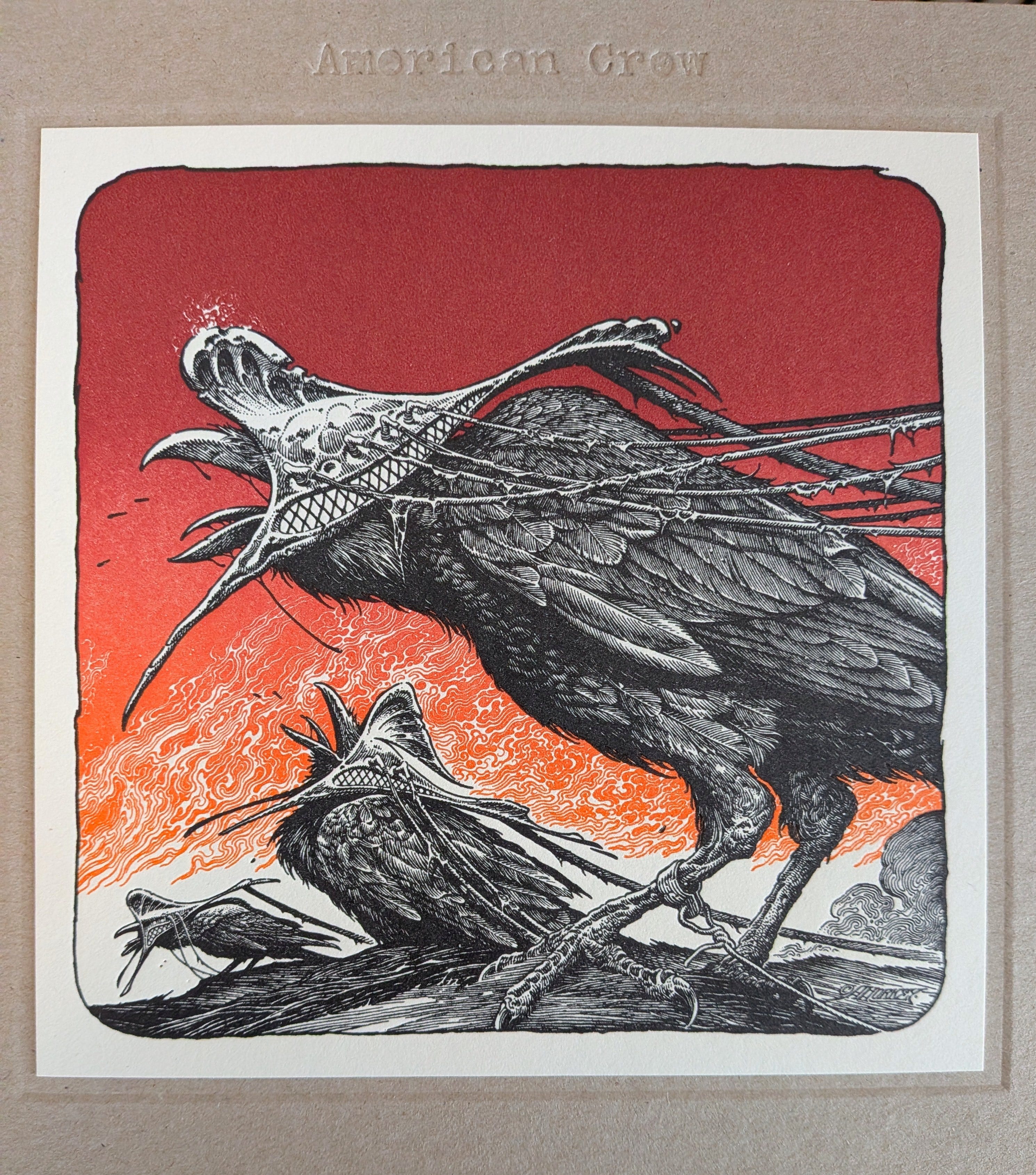
American Crow
Maria Schneider’s American Crow is confrontation without hysteria: instability held in elegant hands.

Most people have never heard of Maria Schneider.
That is not a reflection of her stature. It is a reflection of an attention economy that rewards compression, velocity, and outrage while quietly marginalizing artists who build slowly and refuse to dilute scale.
Schneider should be understood not simply as a jazz composer, but as a modern orchestral composer working through a jazz-sized ensemble. Jazz is her material, not her boundary. She writes with the orchestra itself, using density, register, timbre, and silence as primary materials, treating the band less like a lineup of soloists than a single instrument. Harmony matters, but it’s never the point. She doesn’t write chord changes and orchestrate them. She orchestrates time. American Crow clarifies the scale of her achievement: she is not decorating standards or refining templates. She is composing in the present tense, with control, invention, and architectural power.
Her compositional DNA fuses two giants: Bob Brookmeyer and Gil Evans. From Brookmeyer she absorbed long-form development: a big band not as a sequence of features, but as a single organism capable of accumulating and releasing tension over extended arcs. From Evans, during her apprenticeship as his assistant, she learned orchestral transparency and restraint. He painted with air. He thinned textures until a single sustained line could carry the emotional weight of an entire ensemble. Schneider internalized that discipline.
The result is a decisive departure from the traditional head–solos–head format. Instead of theme, blowing, recap, she favors through-composed trajectories. Themes transform rather than repeat. Solos emerge from texture rather than interrupting it. Recapitulation feels like narrative return, not contractual obligation.
In the early 1990s, she confronted an industry that was male-dominated and structurally allergic to the cost of large-ensemble recording. Big bands are expensive. Rehearsal time is expensive. Female bandleaders were rarer still. Label skepticism was not subtle.
She opted out.
Schneider made ArtistShare a proof of concept, using the early direct-to-fan model to fund large-ensemble recording on her own terms. Her 2004 album Concert in the Garden became the first Grammy-winning recording not sold through retail stores. This was not branding. It was leverage: a bypass around label gatekeepers and the streaming treadmill, and a way to secure listener-backed time for rehearsal, orchestration, pacing, and silence between projects. She protected form from compression and art from algorithm.
Her discography traces a widening vision. Evanescence established her orchestra and earned early Grammy recognition. Concert in the Garden expanded her harmonic palette while proving direct-to-fan sustainability. The Thompson Fields turned pastoral and expansive, rooted in Midwestern memory. Data Lords confronted the digital colonization of attention and became a Pulitzer finalist.
American Crow is the next movement in that arc. If The Thompson Fields was landscape and Data Lords was warning, this record is confrontation.
It is beautiful.
That must be said before analysis. Before metaphors about curated rage. Before diagrams of stacked seconds and withheld thirds.
American Crow arrives as an EP, almost an anomaly in a career defined by large forms. Three tracks. A title piece presented in two versions, one of them threaded with the actual sound of crows. The formal choice matters: compression, in her hands, is not surrender. It is focus.
The opening refuses comfort. Muted trumpets compress the sound into something sharp and avian. Low reeds darken the floor. Harmony stacks fifths and seconds into vertical clusters that feel elemental. She withholds the third, so the harmony won’t tell you what to feel. Major or minor is deferred. The listener is suspended inside ambiguity.
Because the dissonance is shaped. The abrasion is contoured. Nothing spills. Nothing panics.
Then the music breathes.
The ensemble thins. Density recedes. Long lines stretch across modal ground. Air enters the room. The shift from cacophony to reflection is not sentimental; it is engineered. She prepares it through registral spacing and gradual subtraction. The quiet is not retreat. It is perspective.
That contrast is where the beauty resides.
Schneider understands restraint. In an era addicted to immediacy and amplitude, she shapes dynamics like architecture. Her climaxes don’t explode. They arrive. Forte passages bloom and contract. Entire sections wait, until their entrance alters the spectral field. Nothing floods the canvas without purpose.
Her harmonic language is complex but lucid. Modal centers drift, yet the architecture holds. Bass lines pivot beneath sustained upper voicings, subtly shifting harmonic gravity without theatrical announcement. Vertical stacks may omit the third, suspending character, but when it returns the chord regains identity with quiet inevitability.
Rhythm unsettles without abandoning pulse. The opening fractures meter: 4/4 tilts toward 3, snaps into 2, then reforms, while the subdivision stays intact. When harmony floats, rhythm locks. When rhythm destabilizes, orchestration thickens. If she were to unmoor both simultaneously, the effect would be disorientation. She does not. Variables are offset with precision. The system strains but never collapses.
The orchestration is distinctly American in breadth and shadow. Five reeds, including bass clarinet and optional contrabass clarinet, provide a sub-foundational darkness most big bands avoid. Muted trumpets create bite without glare. Accordion bridges chamber intimacy and vernacular memory. Guitar adds voltage without spectacle. Even the wood block punctuates with dry insistence. This isn’t nostalgia. It’s vernacular memory rebuilt as modern syntax.
At the center, a trumpet line from Mike Rodriguez emerges not as conqueror but as participant. The orchestration clears. The harmonic field opens. The line arcs across modal terrain that resists easy cadential gravity. Vulnerability is supported by structure. The solo converses. It does not dominate.
That is why it stays beautiful.
Even at its most abrasive, it refuses hysteria. Even at its most dissonant, it maintains melodic logic. Escalation occurs inside control. Density is modulated with care.
Schneider has argued that musicians were among the first casualties of the data economy, mined, quantified, and traded as information. “American Crow” answers that condition not with noise but with discipline.
Instability without collapse. Dissonance without chaos. Clarity emerging from tension honestly held.
And that is the quiet rebuke. Most of the culture is built to keep you twitching, clicking, swallowing sugar, mistaking stimulation for meaning. Schneider builds the opposite: attention that can withstand discomfort without converting it into spectacle.
In a century drowning in volume, that kind of beauty is not decorative.
An orchestra that can sustain dissonance without screaming, and resolve it without theatrics, is not a luxury object. It is a model of seriousness, and maybe a small lesson in how to live inside pressure without surrendering form.
“American Crow” is, simply, an American classic.
I can honestly admit I don't know if I "get" this as commented below because I don't know what one is supposed to "get.". I just read your post and listened to what you attached in the link and enjoyed the music--even if it wasn't meant for someone like me.
Thank you for sharing it.
As an artist musician, I appreciated your comments, Then I listened. To the entire piece. 94.85% of people will not "get" this. Yay for for the minority. That who this is for!