

Becoming American

“You can go to live in France, but you cannot become a Frenchman.
You can go to live in Germany or Turkey or Japan,
but you cannot become a German, a Turk, or a Japanese.
But anyone, from any corner of the Earth, can come to live in America and become an American.”
— Ronald Reagan, 1989
He said it like a blessing. We watched it turn into a lie.
On October 21, 2025, Canal Street became a proving ground for state power. More than fifty federal agents in tactical gear stormed Lower Manhattan, masked and moving past tourists like dogs on the hunt. They arrested nine men—mostly West African street vendors—and justified it with a phrase so sterile it gleamed: “intelligence-driven enforcement.” An armored vehicle idled nearby as protesters chased the agents down Lafayette Street. The state flexed its muscle on the city’s neck.
They said they were cracking down on counterfeits. The NYPD already does that job, and it’s no secret where to buy a fake Louis Vuitton bag in Manhattan. Do you really need fifty armed agents for a pocketbook raid? What they were really cracking down on was difference—brown skin in daylight, the unavoidable “other,” the face that makes power flinch, the accent that makes a badge feel brave. Domination sold as law.
That same week, in Harrisonburg, Virginia, sixteen-year-old Jaykie Funez-Andrade filmed federal agents arresting her mother during a morning drive to school. The mother had provided everything—work permit, Social Security card, driver’s license, registration—but when she couldn’t recite her Social Security number from memory, an agent lunged. “He became flustered,” Jaykie said later. “Then he just grabbed her.” Her mother is now detained in Rockingham County Jail with no criminal charges, held as a “courtesy” to ICE. Jaykie’s voice, trembling through the camera: “I want this video out there because I want my mother home.”
I guess this was the “worst of the worst” Stephen Miller warned us about…
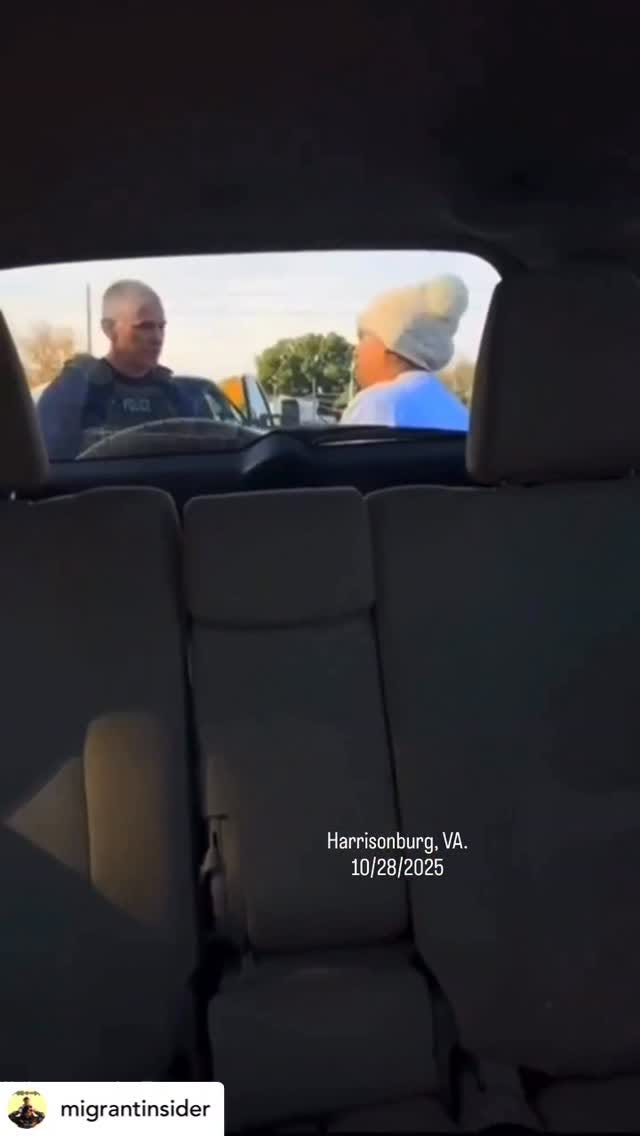
That’s not law enforcement. That’s state cruelty in broad daylight.
We’re living under a government fluent in the language of a fascist state. The same words echoed in Italy and Germany in the 1930s: order, purity, security. The uniforms change; the sentences don’t. Every press release reads like a translation from that era—neat, precise, sanitized. “Public safety.” “Illegal presence.” “Counterfeit crackdown.” Language engineered to bleach the blood out of violence.
Last night at Ole Miss, an Indian student demonstrated more courage than anyone in the press in 2025. She stood at a Turning Point rally and asked J.D. Vance the only question that mattered:
“How can you sell us a dream and then tell us we don’t belong here anymore?”
He began his stock answer, but she stopped him. For a heartbeat, the air held its breath. Then he wrapped himself in the flag and started spitting the words his audience came to hear—“security,” “sovereignty,” “law and order.”
The crowd howled like they’d been saved.
That was the answer—not in his words, but in their applause.
And when you stop and really think about it—if someone had told you in 2015 that this is what America would look like—you’d have laughed, or they’d have written you a prescription for Risperdal. But here it is: the nightmare, normalized. A mother thrown to the ground. A child crying on the shoulder of a road. A country that calls itself free pretending it can’t hear.
Reagan’s promise once meant anyone could come here and become an American. Now it means anyone can be treated as prey. We still wave the flag, but we’ve forgotten what it was supposed to mean. Every time we look away, every time we stay silent, it pulls us closer to the edge of what we swore we’d never become.
Every act of sanctioned cruelty cuts another letter out of the word freedom.
CODA
“Alabama” - John Coltrane (1963)
There’s a grief in this country older than our headlines. You can hear it in Coltrane’s horn.
Recorded in November 1963—barely two months after the 16th Street Baptist Church bombing in Birmingham—Alabama stands as John Coltrane’s quietest act of protest. The quartet—Coltrane on tenor saxophone, McCoy Tyner on piano, Jimmy Garrison on bass, and Elvin Jones on drums—shows extraordinary restraint and sensitivity to the subject. Each player sounds aware of the weight of silence. There is no display, no anger shouted through the horn. The whole piece breathes like a nation holding its grief in its chest.
The structure is disarmingly simple: a slow, modal lament built around C minor, with subtle shifts to Ab major and Bb/C that never fully resolve. It’s not harmonic complexity that gives Alabama its power—it’s the purity of the progression, the deliberate sparseness that leaves room for the spirit to move. Tyner’s chords hang like heavy curtains, often voiced in fourths, their gravity more emotional than functional. Garrison walks gently, anchoring the phrases like a pulse that refuses to quit. Jones’s drums are wind and whisper—time suspended, breath measured.
Coltrane’s improvisation is scalar and speech-like, drawing from the natural minor and Dorian inflections that echo the cadences of the black church. He doesn’t build vertical stacks of harmony here; he moves horizontally, like a preacher pacing the floor. Each phrase mirrors the rhythm of spoken lament—triplets that rise, falter, and fall again. Near the end, the horn lifts into a cry that is both exhausted and pleading. It longs for grace and the goodness of man, reaching upward not for triumph but for mercy.
This is one of the most effective expressions of pain ever captured on tape. The melody doesn’t dramatize suffering; it dignifies it. The quartet doesn’t so much play the tune as guard it—holding space for the dead and for the living who are still learning how to listen. In its simplicity lies its transcendence: music stripped to moral essence, grief purified into sound.
And meanwhile, here we are between the devil and the deep blue sea, our ship's captain, Ahab, chasing the rogue white whale. Hope our story has this in common with Melville's--that it ends with the captain being dragged into the depths of his own madness.
truly beautiful. I cited you in an upcoming post, think it'll slate it for Saturday just fyi. you have a unique lyricism more people should hear. you're def one of the best writers on substack.