

Keep Hope Alive

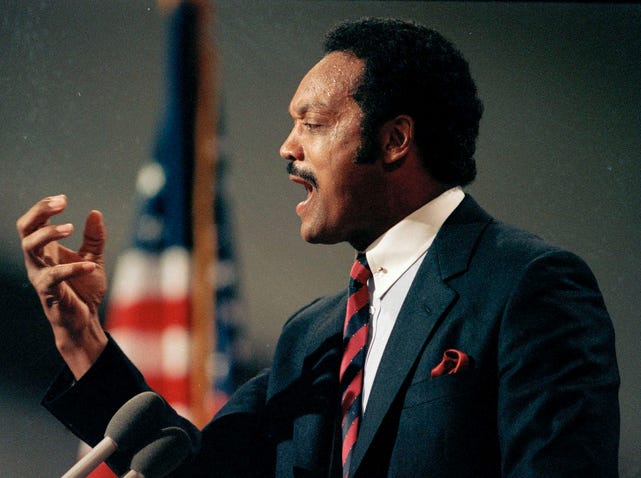
“Both tears and sweat are salty, but they render a different result. Tears will get you sympathy; sweat will get you change.”
— Jesse Jackson (1941-2026)
Jesse Jackson is dead, and the country feels suddenly older.
And the loss feels larger than a single life. It feels like the quiet closing of a bridge between eras, the kind you only notice when you reach for it and it isn’t there. Because he never held executive office, never signed legislation, never commanded troops. He did something harder and less clean: he widened the count. He stood before institutions that had grown comfortable discounting entire communities and forced them to recognize who counted, and he did it not once, but again and again, by force of presence, by repetition, by the stubborn physical labor of refusing to leave.
“My constituency is the desperate, the damned, the disinherited, the disrespected and the despised.”
That was not poetry. It was indictment. If those were his constituents, then the political system had been designed to exclude them. And if the system was designed to exclude them, then the moral argument was not enough. Someone had to translate moral language into arithmetic. Someone had to turn grief into turnout, and prayer into pressure, and the heat of a sermon into the cold mechanics of delegates and rules and thresholds.
Jackson stood in Memphis in April 1968 during the sanitation workers’ strike. He was there when Martin Luther King Jr. was assassinated. The years that followed tried to turn 1968 into a relic, a documentary you could rewatch from a safe distance. But the people who live between eras do not get the comfort of distance. They absorb the friction of transition. They get blamed for the noise, and judged for the compromises, and haunted for the sins of the moment. Their reputations are never clean because their job is never clean.
The second image everyone remembers is 2008, when Barack Obama secured the presidency. Jackson’s face, as if the body itself had finally granted permission to feel what it had refused to feel for decades. No sermon. No flourish. Just the stillness of a man who had run twice and been told twice that the country was not ready, and who lived long enough to see readiness arrive in someone else’s form.
But to understand the bridge, you need a third image, quieter than the Lorraine Motel and smaller than Grant Park. Something humble. Something repetitive.
It is winter, late 1980s, on a Manhattan sidewalk. Healthcare workers from Local 1199 outside a hospital entrance, bundled and rigid, coffee steaming from paper cups that cannot warm the hands holding them, signs sagging under sleet, breath turning to grainy fog in the air. The chant has that tired wobble that comes when people have been standing too long and the cameras are gone and the world is moving past them. Then Jackson steps forward and takes the bullhorn, and there is a pause, not dramatic, not staged, just a beat where he gathers himself. He adjusts his grip. He rolls his shoulders as if making space for the job. He draws the kind of breath you only draw when you’ve done this your whole life. And then the cadence arrives, not as performance but as calibration, and shoulders square, and volume rises, and the line holds.
That’s the bridge. Not steel. Not marble. Time. Exhaustion. A life spent stepping into the wind and making other people stand taller inside it.
In 1988, Jackson won nearly seven million primary votes, twenty-nine percent of the Democratic electorate. That was not symbolism. That was leverage. His campaigns did not merely seek delegates. They altered who qualified as a participant. Black voters. Young voters. Indebted farmers. Laid-off steelworkers. Latino families in emerging states. People treated as outreach targets and photo ops and afterthoughts. He treated them as a governing bloc, as a bargaining unit, as the missing arithmetic of a party that preferred narrower margins.
The Rainbow Coalition is often remembered as a slogan. It was infrastructure. It attempted to bind poor Black workers, displaced white laborers, immigrant families, small farmers, and the rural abandoned into a single negotiating position inside a party structure that preferred separate rooms and smaller demands. Not a collage of grievances. A bargaining unit. An uneasy, ambitious alignment of people who did not always trust one another but understood that isolation meant irrelevance, and that irrelevance was the quiet death America assigned to the people it did not want to see.
He liked to describe his grandmother sewing scraps, wool and silk and croker sack, into something durable. The metaphor was simple. The implications were not. A nation that discards parts of its population cannot govern coherently. Binding those parts together is not sentiment. It is survival. And it was labor: endless handshakes, long nights, cheap flights, cold corridors, banquet halls, union basements, churches, campuses, courthouse steps, and the steady salt of sweat that comes from showing up when it would be easier to stay home.
He was ambitious. He cultivated myth. He also wounded his own coalition. In 1984, he referred to New York City as “Hymietown” in a private conversation that became public. The remark was antisemitic and indefensible. He apologized and sought repair, but coalitions built on dignity crack when language betrays them. His flaws were real. So was his willingness to remain in the arena after them, to keep working, to keep bargaining, to keep insisting that a coalition is not a mood but a discipline, not a selfie but a structure.
He operated outside approved lanes. He traveled to Damascus and Havana to negotiate the release of Americans, frustrating administrations in both parties. He treated diplomacy like direct action: go where the problem is, trade prestige for a life, and accept the backlash later. In 1984, he helped secure the release of U.S. Navy pilot Robert Goodman from Syria, a moment that made his methods impossible to dismiss as mere performance. Supporters called it moral intervention. Critics called it freelancing. Either way, it revealed something essential: he did not believe permission was required to do what he thought was right. He believed you entered the room, and stayed, and made the room change around you.
He insisted on naming. He argued for “African American” as a name that held both ancestry and citizenship. He translated church rhythm into delegate arithmetic. He made moral vocabulary collide with party rules. He did not simply witness history. He tried to force the future to show its face.
We keep replaying 1968 like it’s a documentary. It isn’t. It’s instruction.
Jackson’s generation didn’t inherit calm. They inherited fracture and chose engagement anyway. Leaders were assassinated. Cities strained. Trust thinned. And still people organized, and voted, and negotiated, and endured. Jackson carried that refusal forward, and he carried it with a body, and a voice, and a schedule that wears a man down, and a kind of faith that is less a feeling than a practice.
The tears of 2008 were not spontaneous. They were the delayed payment on decades of sweat. They were the salt that comes when the body finally allows itself to acknowledge what it has survived, what it has carried, what it has forced into existence by showing up in the cold when sympathy would have been cheaper.
“Keep hope alive” was never a slogan about mood. It was instruction about discipline. Hope required turnout, and organization, and negotiation, and sweat. It required standing in the wind after the microphones had moved on. It required the stitching.
And now the stitcher is gone.
The bridge he built was not made of stone but of a thousand Sundays, ten thousand handshakes, and the relentless salt of a life spent in public. Now that the bridge has closed, we find ourselves standing on a far shore he imagined for us before we were brave enough to see it. The stitching remains. The cloth is durable. But now, there is silence.
The silence is the part you feel in your chest.
Scraps become cloth only if someone insists they belong together.
He insisted. In public.
Thank you, Mark for this heartfelt tribute. I am weeping uncontrollably at the loss of Jesse Jackson. He was the last of the great civil rights leaders that I admired since my childhood in the 1960s. Rest in Power, Reverend. I will always Keep Hope Alive. 🌈 🤜🏼🤛🏽 💙
Perfect; brilliant. 🙏