

Shattered Dials and Recovered Time: A Huntington’s Breakthrough

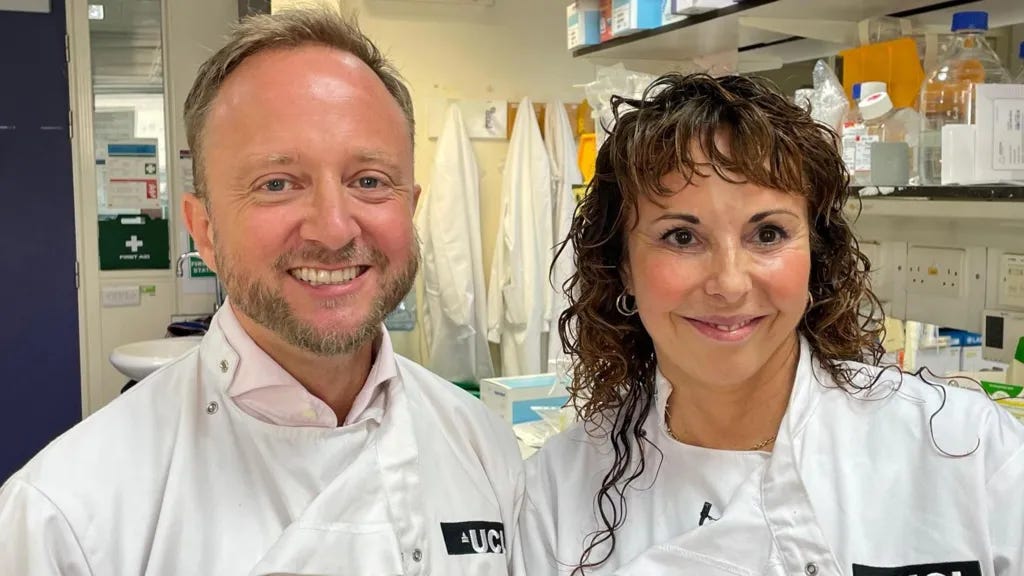
Professors Ed Wild and Sarah Tabrizi from UCL
This is the kind of news that makes me miss the old days—phones ringing off the hook, trading desks roaring, sixteen-hour stretches powered by burnt coffee and adrenaline. Because this is the win you wait a career for.
Huntington’s disease has always been the cruelest form of genetic Russian roulette: one bad gene, a coin flip of inheritance, and an inevitable decline that strips people down until they’re shadows. For decades, the whisper across labs and boardrooms was the same: if gene therapy works anywhere, it will work here. But we watched trial after trial collapse, companies slink off, hope shrink.
Then came uniQure in the Netherlands. Sarah Tabrizi. Ed Wild. And a global Huntington’s community that refused to give up.
I’ve met Sarah Tabrizi more than once. She’s fierce. Her work mapping the natural history of Huntington’s gave the field its playbook—how to measure decline, how to design a trial, how to ask the right questions. Without that scaffolding, this moment doesn’t exist.
And the moment is this: a 75% slowing of disease progression. That’s not incremental. That’s a jailbreak. A year of decline stretched into four. Instead of a wheelchair in your forties, you might still be walking in your sixties.
The mechanics are surreal. Twelve to eighteen hours on the table while neurosurgeons snake microcatheters into the caudate and putamen, dripping a modified virus into the brain’s control center. The virus delivers its payload. Neurons switch roles, turning into factories that silence the toxic protein. One treatment. Durable. Working.
Yes, it will be expensive. Neurosurgery and bespoke viral vectors don’t come cheap. But cost is the second headline. The first is this: Huntington’s is no longer a guaranteed death march.
Ask Jack May-Davis. He’s thirty. He carries the same faulty gene that killed his father at 54. His father’s final years were spent in 24-hour care. Jack may live to see his grandchildren. That’s the difference. That’s the breakthrough.
From where I sit, this is the moment biotech has chased since the Human Genome Project: proof that we can rewrite biology itself. Not just Huntington’s—this points to Alzheimer’s, ALS, Parkinson’s.
Science didn’t just move the needle. It tore up the scale.
CODA
Beethoven – String Quartet No. 15 in A Minor, Op. 132, “Heiliger Dankgesang”
The first movement opens in suspension, heavy chords dragging under their own weight. Beethoven wrote it after a near-fatal illness, and the music feels bound to the body’s weakness. Out of the stillness comes a small rising second, hesitant at first, then insistent, a fragile signal of life.
When the Allegro bursts in, it’s uneven but defiant. The instruments kick against the bar lines, energy flooding back into limbs. The alternation—frailty, renewal, frailty, renewal—captures the push of survival against decline.
This is what Huntington’s patients are tasting now. The dragging inevitability of loss, slowed. Years stretched. A father gone at 54, but a son who may live long enough to know his grandchildren. The music doesn’t erase suffering, but it breathes. Beethoven, convalescent, found thanksgiving in frailty; the Huntington’s community, after decades of failure, has carved out a future where decline no longer runs unchecked.
Science has given back time. Beethoven left the soundtrack for what that feels like: fragile, defiant, alive.
What great news! Surreal is the perfect adjective for how the slowdown is achieved. Of course, I thought of Woody Guthrie and family--along with all of the families who have been afflicted through multiple generations. Hopefully, you're right about the possibility of the same kind of biotech working for breakthroughs on Alzheimer's, ALS, and Parkinson's.
Thanks for posting this wonderful and positive news.
Boo-yah! But don't mention this to RFK lest he find some excuse to smear it and the scientific method, patience and humanity of its developers.