

The Scaffolding Groans
"It’s easy to ignore trouble, when you’re livin’ in a bubble"

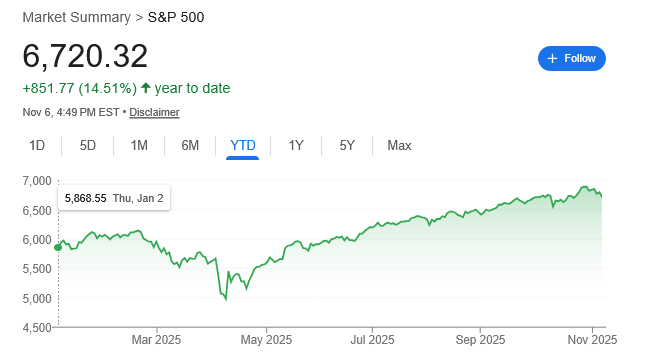
There are a few phrases on Wall Street that make you want to roll your eyes—triangulation, mosaic, visibility into forward earnings. Yet they linger because they describe something real. The analyst’s job, which I did for nearly twenty years, isn’t about prophecy. It’s excavation. You take the fragments of data scattered across the market floor—jobs, debt, prices, sentiment—and scrape the mud off a crystal ball until you can just barely make out the future. Weak hands chase returns. Strong hands read the board. The further ahead you can see, the less likely you are to get caught in the stampede.
The picture right now is grim. October’s Challenger report landed like a hammer: 153,000 layoffs in a single month—the highest October since 2003, and the worst year for cuts since the panic of 2008. The technology sector, which only yesterday was celebrated as the engine of infinite growth, led the carnage with thirty-three thousand jobs eliminated—six times September’s level. “AI efficiency” has become corporate code for payroll reduction. The rest of the labor market hasn’t yet registered the shock in weekly claims, but it will. Anyone who’s seen these cycles knows: pink slips are the leading indicator. The statistics always catch up later.
Meanwhile, household debt has climbed to an all-time high of $18.6 trillion. Credit cards carry $1.23 trillion in balances, student loans $1.65 trillion, mortgages $13 trillion. Delinquencies are called “stable,” though that’s sleight of hand—young borrowers are missing payments at twice last year’s rate. The American consumer, that mythic creature propping up seventy percent of GDP, is running the economy on maxed-out plastic. You can’t build prosperity on a credit-card float forever.
Forget the lazy metaphors about “Jenga towers” or “K-shaped recoveries”. What we have is a top-heavy scaffolding: shining steel above, rust below. The upper tier—homeowners, investors, the stock-market class—still spends freely, wealth buoyed by inflated assets. Beneath them, the middle class creaks under debt, rent, and shrinking paychecks. The load is uneven, and when that happens in any structure, collapse is a matter of physics, not fate.
The Federal Reserve sees the same cracks. Two rate cuts since September, another likely in December. They call it “insurance”; it looks more like triage. Policymakers are trying to cushion the landing before the scaffolding gives way. But you can’t fix structural inequality with monetary spackle. Liquidity isn’t strength—it’s just water poured into the cracks.
Earnings confirmed the macro hints. Apple’s iPhone sales softened, especially in China, though its services masked the weakness. Amazon’s cloud steadied while retail margins sagged under cautious consumers. Microsoft posted robust AI revenue but warned about rising capital costs; Alphabet’s ad engine sputtered; Meta’s profits survived but its “metaverse” still hemorrhages cash. The industrials told a clearer story: Caterpillar’s backlog shrank, Visa and Mastercard said spending growth now comes almost entirely from the wealthy, and Exxon and Chevron lowered demand forecasts. Everyone beat expectations, yet almost no one raised guidance. That’s not optimism—it’s managed decline.
Now comes the next act—confirmation or collapse. Mid-month brings retail sales, the litmus test of the American consumer—the exhausted engine of the entire postwar system. Then the Producer Price Index, a window into corporate margins. If input costs rise while demand cools, you get the worst hybrid imaginable: shrinking profits and rising prices. Housing data follows—a pulse check on what’s left of the middle class’s last anchor of stability.
After that: the government’s second GDP estimate, the November jobs report, and the Fed’s December meeting, where Powell will stand at the podium like a man holding a glass of water in a burning room, insisting it’s under control. Two cuts already, a third on deck. The market will call it “stimulus.” The Fed will call it “insurance.” In truth, it’s fear management. You don’t cut rates in a healthy economy. You cut when you feel the tremor beneath the scaffolding.
Analysts will spend the rest of November pretending to divine meaning from basis points and revisions, but the truth is simpler: we’re running out of middle. Out of middle consumers, middle wages, middle optimism. Growth now comes from the edges—from speculation, from leverage, from the kind of bets that work only in the late innings of a cycle. You can feel the asymmetry hardening. The market may still rally on momentum, but underneath, the bolts are loose.
If those numbers disappoint—and the odds say they will—the market will pivot toward the defensives, the dividend payers, the safe harbors. If inflation revives, yields will spike, valuations will compress, and the soft-landing fantasy will vanish in a day. If growth falters, the Fed will keep cutting, and we’ll call that “accommodation,” though everyone knows it’s morphine. Even if inflation cools and unemployment stays calm, the deeper illness remains: an economy where the rich float above gravity while everyone else feels the fall.
Put the mosaic together—layoffs, debt, rate cuts, cautious earnings, brittle consumption—and you see an economy that looks healthy only from the penthouse. The top ten percent are still sipping champagne in their financial skyboxes while the base strains beneath them. It’s not yet a crisis. It’s something more dangerous: the quiet before one. The sound of denial humming through the trading desks, the press releases, and the living rooms of people who believe the Dow Jones is a mirror of their own lives.
If you want to see how the real speculators are thinking, look at crypto. I’ve never dropped a penny into it, though I’ve looked at the charts and cursed myself for being old-school—wanting to read an income statement, a balance sheet, to understand the prospects of a company instead of playing the “greater fool” theory. But that’s not investing. It’s faith without fundamentals. No wonder Trump’s idiot sons love it.
Those markets are cracking. The pure speculation dissolves first. Then the high flyers—think Nvidia. Finally, the sturdy companies your grandmother owns. In a meltdown, everything gets sold because you have to sell your winners to keep your house.
Strong hands are already moving their pieces: tightening exposure, hedging risk, shifting toward whatever still holds value when the illusion fades. Weak hands are still buying the story of eternal growth through automation, mistaking motion for progress. The market, like the country that created it, is brilliant, delusional, and deeply human—forever believing it can escape the consequences of its own design.
But the scaffolding groans. And somewhere beneath the hum of earnings calls and Fed statements, you can hear the bolts begin to loosen.
Coda — “Ain’t It Fun” (Paramore, 2013)
“If it don’t hurt now, well, just wait, just wait a while
You’re not the big fish in the pond no more
You are what they’re feedin’ on”
That’s the opening salvo—a warning to every finance bro who thought gravity was for other people.
Big guitars. Gospel shimmer. Hayley Williams’ voice like a siren over the wreckage. On the surface, it’s a coming-of-age anthem; underneath, it’s a requiem for arrogance.
So what are you gonna do
When the world don’t orbit around you?
Wall Street’s the ultimate game of musical chairs. You just have to make sure you’re ready when the music stops—because pain doesn’t begin to describe what comes next.
“Where you’re from
You might be the one who’s runnin’ things
Well, you could ring anybody’s bell and get what you want
You see, it’s easy to ignore trouble
When you’re livin’ in a bubble”
That verse belongs to this moment—to every trader, founder, and self-styled genius who believed leverage was wisdom and hubris was skill.
“Ain’t it fun
Livin’ in the real world?”
The scaffolding groans, the bolts give way, and from the speakers comes the final instruction for an age that mistook wealth for invincibility:
“Don’t go cryin’ to your mama, ’cause you’re on your own.”
This: "the living rooms of people who believe the Dow Jones is a mirror of their own lives." Exactly. Why? For most of us the stock market is as far from our reality as a hawk from the moon. Why should we care?
Well, well, well. So those who dwell in the highest branches of the tree are belatedly coming to realize that the tree's roots have had insufficient water for so long that the tree now trembles with every passing breeze and may yet topple in a storm. Well, well, well.